We booked an all day Jeep tour with Looking Glass Jeep Tours that drove us through Hoi An and the neighboring city of Da Nang, as well as the countryside in-between. Our driver/tour guide, Jeremy, is an American that has lived in Vietnam for about 7 years and was extremely knowledgable. His tour takes you to several historical sights, many of which are associated with the Vietnam war, in an open air Jeep that is a legit, Vietnam War-era Army vehicle. Overall, the tour is great, but there are pros and cons.
Pros:
Jeremy plays a lot of 60s, Forrest Gump soundtrack tunes to give the sightseeing a great vibe and brings along old photos which he will superimpose over your view so that you can see comparisons of how the landscape looked during the war.
You get to see the countryside, which you probably wouldn’t see on your own.
Jeremy stops at different parts of tiny villages, like Hua Nan, including the schools. With bags of candy he provides, you can hand out sweets to the schoolchildren in the playground during their recess. It’s intense–my heart was racing as dozens of Vietnamese children came up to the Jeep to get candy. It’s an unbelievable experience.
You get to talk to some of the local children and help them practice their English since they don’t get to do it that often outside of the classroom.
He stops at a slate factory, where you can experience splitting slate with the local workers, and introduces you to a local fishing boat maker, who shows you how he makes the bamboo basket boats like the ones we rowed in near the Coconut City.
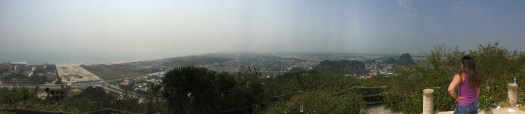
The trip up Marble Mountain is long and challenging, but the view from the top is glorious. You also get to see temples made of old, shattered Heineken and Budweiser beer bottles, and a giant cave that was used as a hospital during the war.
The lunch spot that Jeremy took us to in Da Nang was called Ba Duong. It’s located down a tiny alley that you would never find unless you were a local. There we feasted on Banh Xeo, my second favorite dish of the trip. Banh Xeo consists of rice wraps with these crunchy, corn flour tortilla like things, shrimp, pork sticks, veggies, papaya, and the key ingredient–a savory beef, peanut satay sauce.
Cons:
It’s an open air Jeep, so it does get VERY hot, and you will get sunburned if you don’t put on the sunblock. Jeremy does provide water however.
Jeremy does get very political and keeps bringing up how all the farmers were getting kicked out to develop hotels, roads, etc. He will rant about how there’s no urban planning in place for cars, yet everyone has them now with no place to put them and brings up several other topics that can be a little draining.
The tour will at one point drive through a long tunnel (like miles and miles) and because it’s an open air Jeep, it’s really loud, and gets extremely hard to breathe. Believe me, it’s a very uncomfortable experience. So if that’s something you’re not willing to put up with for 10-15 minutes, don’t take this Jeep tour.
A few days in Hanoi is chaotic at best because there is so much that you can do. Aside from the Ho Chi Minh Mausoleum Complex, Hanoi is full of activities worth checking out. There’s a lot to cover so I’ll get right to it.
Hỏa Lò Prison Museum
30K VND
Open daily 8 a.m. — 5 p.m.
This is probably my favorite of the museums we visited purely because it was so visceral. Nicknamed the “Hanoi Hilton” by POWs during the Vietnam War, this prison held Vietnamese revolutionaries during their struggle for independence from the French as well as famous Americans, such as Senator John McCain. Much of the exhibit consists of prison garments worn by Americans and a lot of propaganda videos portraying the prisoners as being treated super well (which were very amusing). But all these displays were a stark contrast to the dungeon cells that they kept unruly prisoners shackled down in, the main room made to fit only 40 prisoners, but held 100 with only one barrel for a toilet, and the several methods of torture on display, along with the french guillotine used for executions.
This slideshow requires JavaScript.
Vietnamese Women’s Museum
30K VND
Open daily 8 a.m. — 5 p.m.
The Vietnamese hold their historical women in high regard, and that is reflected in this museum. This, along with the Hỏa Lò Prison, I think are a better combination of museums that show the history of Vietnam than the actual National Museum of Vietnamese History (coming up). The exhibits in this museum highlight all aspects of what it means to be a woman in Vietnamese culture and shows profiles of numerous women of different historical backgrounds. Some standout parts for me were seeing the bamboo tubes used to keep umbilical cords until that child passes away, a bracelet given to a girl fighting the French with her name on it, so that if she died her father could ID her body, and the picture of a mother embracing her son who she thought was a traitor for years, but in actuality was a double agent.
This slideshow requires JavaScript.
Walk around Hoàn Kiếm Lake
There’s no way you won’t walk along this lake at some point if you’re staying in the Old Quarter. Whether during the day or night, this serene body of water offers a nice getaway from the crazy traffic and there’s a good chance you’ll see folks dancing or doing Tai Chi on the shores. Take a walk over the Huc Bridge and check out the Ngoc Son Temple (Open daily 7:30 a.m. — 5:30 p.m.; 20K VND) to learn more about the myth of the giant turtle who lives in the lake and protects the magical sword used to drive the Chinese out of Vietnam.
National Museum of Vietnamese History
40K VND/Adult, 15K VND/Student
Open daily 8 a.m. — noon, 1:30 p.m. — 5 p.m.
Closed 1st Monday of the month
For an overview of the history of the area, this museum encapsulates all of Vietnam’s culture and heritage dating back to its prehistoric periods. While the Hỏa Lò Prison Museum and Women’s Museum were a bit more engaging to me than this one, if you’re into archaeology, this is the place for you. On top of the prehistoric fossils and relics, the museum features several of Ho Chi Minh’s manuscripts, anti-French revolutionary artifacts, and more Vietnam War stuff. They say no photos are allowed, but no one seemed to follow those rules, so snap away.
This slideshow requires JavaScript.
Bach Ma Temple
No charge
Open Tue-Sunday 8 a.m. — 11 a.m., 2 p.m. — 5 p.m.
We stumbled upon this temple completely on accident, and were drawn in because they were having a concert that was open to the public. We discovered that it is supposedly the oldest temple in Hanoi. It had the most elaborate decorations of the temples we’d see in the city, and was so compact it kind of felt like going to your hoarder grandma’s house with all her trinkets and stuff everywhere (though this could be due to the fact that there was a concert going on).
Temple of Literature
30K VND/Adult, 15K VND/Student
Open daily 8 a.m. — 5 p.m.
This temple is dedicated to Confucius and is much larger than the Bach Ma Temple. It’s made up of multiple plazas and displays several dozen stone tortoises with doctors’ stelae (a stela is a tablet that acts as the story/diploma of the doctor). Multiple pagodas in the temple house shrines to kings and Confucius, and it’s easy to see how this quiet complex would be a nice place for studying.
Long Bien Bridge
If you want to go for a bit of a hike, check out the Long Bien Bridge. A symbol of the Vietnam War, this bridge was bombed by the Americans numerous times, but was always repaired and to this day represents Hanoian resilience. We didn’t actually make it all the way across, but that shouldn’t stop you if you want to try.
Mido Spa
26 Hàng Mành, Hàng Gai, Hoàn Kiếm
Hà Nội 10000, Vietnam
Open daily 9 a.m. — 11 p.m.
Like the rest of Southeast Asia, there’s no shortage of places in Vietnam to get a massage. While I can’t speak to all of them in Hanoi, Mido Spa was quite nice. Being so affordable, I decided to try a hot stone massage for the first time and with that experience I’ve pretty much ruined all other massages for the rest of my life. The hot stones worked out the kinks better than any Swedish, Sports, Thai, or Deep Tissue massage I’ve done in the past. So with all the walking you’ll be doing, take a few hours off, and for about a quarter of the price you would pay in the U.S.– “Treat yo self!” (There are no photos because that would just be weird.)
and for cheap!
Drinking on Ta Hien and surrounding area
At night, Ta Hien and the surrounding area turns into a smaller version of Pub Alley in Siem Reap. Tons of people are out on streets enjoying beers and street food. If you want to go really cheap, look for Bia Hoi (25 cent beers) signs and have a seat. Bia Hoi generally isn’t offered at the normal bars; it’s just random people who make kegs of it and sell it out of their homes, but it’s an actually pretty okay pilsner and, in some cases, tastes better than the already cheap $1 corporate stuff like Bia Siagon or 333. It was at one Bia Hoi stand that we met a couple from Chicago who were wrapping up a four year Peace Corps stint. We drank multiple beers together for three to four hours and our tab ended up being about $10 total! It’s in this area you can also catch live music on the streets, see the amusing “Obama” Bar, or go into a club and inhale helium out of weird balloons that they sell (really, really popular with the locals and the most bizarre thing I’ve seen at a club). They’re pretty strict about their curfew in Vietnam, so don’t expect to go out partying super late.
Dong Xuan Market and Night Market in the Old Quarter
Dong Xuan hours: Daily 7 a.m. — 9 p.m.
Like many other markets around the world, Dong Xuan Market offers the usual food, clothes, electronics, gifts, etc. for locals and tourists. On the weekends in the Old Quarter, several blocks are closed to motor traffic in order to have a pedestrian only street market that starts at Dong Xuan and runs south to the Hoan Keim Lake. It’s definitely worth taking a walk down to see, but for my money, I’d save the souvenir shopping for Hoi An (that post is upcoming).







 Here and There